

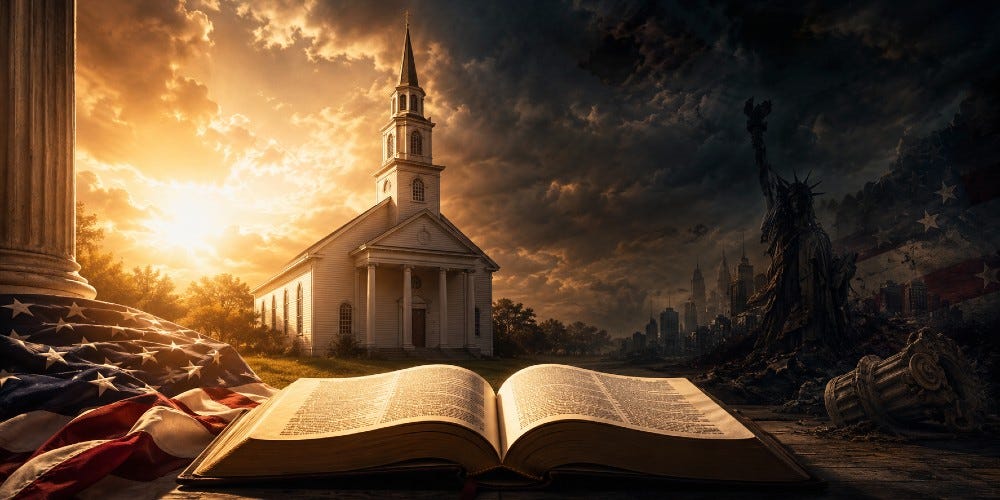
Freedom feels ordinary until it slips away. In America today, millions rise each morning under liberties so familiar they barely register: the right to gather in worship, teach Scripture to children, speak biblical truth aloud, and live according to conscience. Yet these blessings did not emerge from nowhere. They were purchased through sacrifice, rooted in conviction, and entrusted to generations who understood their divine source.
When the church forgets this inheritance, the nation follows into ingratitude. A people who lose sight of what God has given soon treat it as their due rather than a sacred trust. The result is a culture adrift, careless with liberty and blind to the Author of every good gift.
Our story begins with those who refused to bow to earthly powers in matters of faith. The Pilgrims braved the Atlantic not for wealth or adventure, but to worship God without interference. Their Mayflower Compact acknowledged divine sovereignty before any human authority.
Later, the Great Awakening stirred the colonies through bold preaching that placed every soul directly accountable to the Creator. Men like Jonathan Edwards and George Whitefield reminded hearers that rights flow from God, not kings or parliaments.
By the time of independence, this conviction shaped the founding documents. The Declaration declared rights “endowed by their Creator” — unalienable precisely because government did not grant them. This principle set America apart: liberty grounded in truth, protected by virtue, and accountable to heaven.
Ronald Reagan captured the fragility well when he observed that freedom is never more than one generation from extinction. It must be taught, defended, and handed down intentionally.
Today, that chain of memory frays. Many churches treat religious liberty as a comfort rather than a commission. We enjoy freedoms our brothers and sisters in restricted nations can only pray for, yet too often respond with apathy instead of action. The Gospel goes unproclaimed while cultural pressures mount. Biblical truth yields to convenience. The next generation hears more about rights than responsibilities.
The High Cost of Forgetting
History warns us plainly. Nations that sever themselves from their spiritual foundations drift toward tyranny dressed as progress. When rights are seen as gifts from government rather than God, they become negotiable. What the state gives, the state may redefine or revoke. We see this pattern in courts that subordinate conscience to ideology, schools that sideline parental authority, and a public square increasingly hostile to open faith.
Christians bear particular responsibility here. Religious liberty is not an end in itself. It serves a greater purpose: the advancement of Christ’s kingdom. It allows open preaching, missionary sending, church planting, and the training of children in the fear of the Lord. To squander this stewardship through forgetfulness is to invite the very loss we claim to dread.
A forgetful church breeds an ungrateful nation. And ungrateful nations grow reckless with their blessings, trading eternal principles for temporal ease. We see echoes of this in declining church attendance among the young, the normalization of practices Scripture condemns, and a patriotism stripped of its Judeo-Christian core.
Stewardship Demands Remembrance
Yet there remains cause for hope if we choose the path of memory. Scripture calls God’s people repeatedly to recall His works. Joshua rehearsed God’s faithfulness to Israel before demanding covenant loyalty. The psalmist declared his resolve to remember the Lord’s wonders of old. Such remembrance fuels gratitude, which in turn produces faithful action.
American Christians must recover this discipline. Teach the founding generation’s reliance on providence. Proclaim the Gospel boldly while the doors remain open. Pray for the nation with humility, seeking its good as exiles who hold dual citizenship. Use liberty not merely to preserve comfort, but to serve neighbors and glorify God.
This is no shallow civic religion. It is grateful stewardship under heaven’s gaze. Our ultimate allegiance belongs to Christ, not any earthly flag. Still, as long as God keeps us in this land, we labor for its welfare — not as those who trust in princes, but as those who know every blessing traces back to the Father of lights.
“Seek the peace of the city whither I have caused you to be carried away captives, and pray unto the LORD for it: for in the peace thereof shall ye have peace.” (Jeremiah 29:7)
Paul Chappell reminds us that freedom is too precious to forget. The church that remembers its history will live with conviction. The nation that follows such a church may yet rediscover the source of its greatness. In an age of institutional decay and cultural amnesia, few tasks matter more than this: passing on a faith that remembers, a gratitude that acts, and a liberty tethered firmly to truth.
What has been forgotten is that Jesus is the Creator (John 1:3). What has been forgotten is the real and true Gospel of Jesus Christ. What has been forgotten is what it means to be truly born again, indwelled by the Holy Spirit, with restored conscience strong enough to overcome wickedness, informed by the implanted word (James 1:21, etc.). Jesus restored the liberty that was lost by Adam's sin. It is because of Jesus that we can have life, liberty, and happiness. And the reason is because a righteous people can be free. But a wicked people must be constrained and controlled. It is by the power of the Holy Spirit, the supernatural work of our Creator, to not just constrain and control works of wickedness, but to cure it and drive it out from within the heart and mind of man.
Slavery is ultimately enslavement to sin. It is the heart of men enslaved to the wicked and corrupt flesh and corruption of creation from the sin of Adam. The enslaver is also a slave. The founders understood this, and many warned, John Adams being one of the most notable, that our liberty is dependent on whether or not we are righteous and virtuous people. It hinges on whether or not we are able to self-govern (as individuals able to govern ourselves first and then out of that our ability to self-govern as a people) because of the work of the Holy Spirit within us. One who will do what's right, no matter how difficult, no matter how much the cost, is able to self-govern. But one who will yield to wickedness, particularly when things get tough, is not able to govern himself, much less participate in any collective self-governance of the people. Where wickedness abounds, there is no liberty.
Our liberty is entirely dependent on the Gospel of Jesus Christ.
There were certain deists among the founding fathers, most notably Thomas Jefferson. He wrote that God had "endowed" us with certain rights. However, if a sovereign God had given "all men" something, then all men would have it. Rather, it is better understood that we "ought" to have these rights because we are made in God's image. In truth, these rights were appropriated by the men of the Continental Army, and secured by, political agreement, in the US Constitution. Today many Americans (if not most) believe in the sovereignty of man. They take the high view of man and the low view of God. Pray for revival in America.