

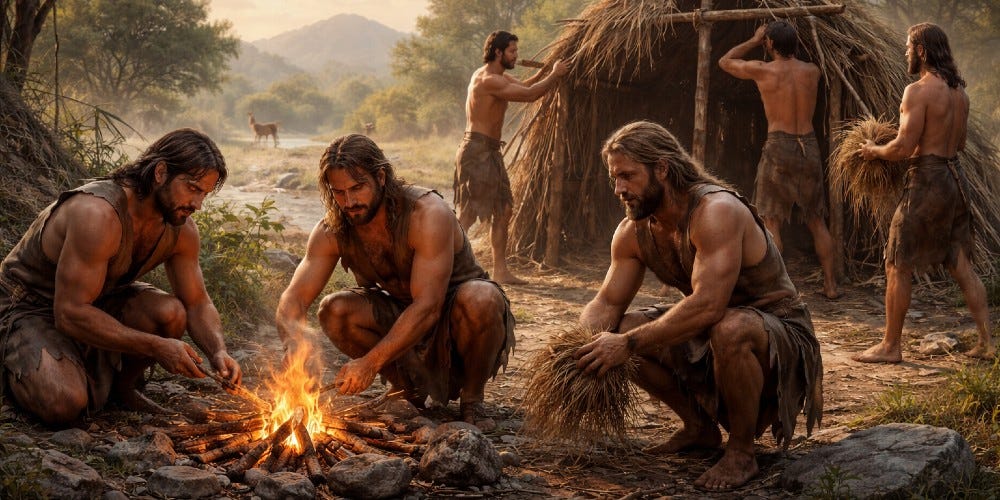
For more than a century, the story told by secular academia has been confidently linear: primitive ape-like creatures slowly evolved into modern humans over hundreds of thousands of years, with Neanderthals representing a kind of evolutionary dead-end — brutish, grunting near-humans who lacked the cognitive sophistication to survive alongside Homo sapiens. This narrative has been presented not as a hypothesis but as settled science, and it has shaped how Western culture thinks about human origins.
But what if the story is wrong — not only scientifically, but fundamentally?
A growing body of archaeological and genetic evidence is forcing mainstream researchers to radically revise what they thought they knew about so-called “primitive” humans. At the same time, a careful reading of Scripture suggests that the people described in early Genesis may align far more closely with these ancient peoples than the secular academy has ever been willing to admit. The question deserves serious examination: Could the humans labeled “Neanderthals” and other archaic peoples simply be the pre-Flood and post-Flood descendants of Adam and Eve?
The Myth of the Brutish Neanderthal
The popular image of the Neanderthal — stooped, dim-witted, barely verbal — was never really about evidence. As Professor João Zilhão of the University of Barcelona has noted, early anthropologists’ dismissal of Neanderthal intelligence was partly rooted in racist ideology, operating on the discredited belief that skull shape could determine cognitive capacity. Scientists of the era also shared a deeply held assumption that evolution moves in a straight line from lesser to greater, meaning ancient peoples must have been inferior. Those assumptions, as even mainstream researchers now acknowledge, have been thoroughly discredited.
What the actual archaeological record shows is striking. Neanderthals made and used sophisticated stone tools, including the highly refined Levallois technique, which required planning multiple steps in advance. They manufactured a complex adhesive — birch tar — through a carefully controlled anoxic heating process that demanded, as researchers from the University of Seville concluded, “a significant degree of organisation and practice.” They crafted multi-component tools, invented rope by weaving three-strand cord (indicating, according to researchers, a working understanding of basic mathematics), and adapted their tool technology intelligently to the specific animals they were hunting. They used fire not merely to cook food but to create synthetic materials.
Their social behavior was equally sophisticated. Evidence from multiple excavation sites shows that Neanderthals cared for their injured and elderly — individuals who could not have survived without active, long-term support from their community. A recently discovered fossil of a Neanderthal child with Down syndrome confirms that their society extended compassionate care even to those who could contribute little to survival. They organized socially in ways that included female mobility between groups — a complex social structure that mirrors patterns seen in later human civilizations.
As Guillaume Guérin, a research scientist at Geosciences Rennes, concluded after extensive study: “The more we look at these different criteria and trends that could be characteristic for modernity, actually there is not so much difference between the Neanderthals and modern humans.”
Not so primitive after all.
Art, Ritual, and the Imago Dei
Perhaps most significant for the Christian reader is what the archaeological record reveals about Neanderthal spiritual and symbolic behavior — the very capacities that Scripture identifies as unique to beings made in the image of God.
In 2018, the discovery of cave art in Spain attributed definitively to Neanderthals — painted at least 64,000 years ago, some 20,000 years before Homo sapiens arrived in Europe — upended long-held assumptions in anthropology. These were not random marks. They were deliberate, symbolic creations. Shells with artificially drilled holes, coated in decorative red pigment, were found at multiple sites, suggesting jewelry-making and personal ornamentation. Eagle talons were shaped into pendants. Feathers from birds of prey were collected — apparently for adornment, not consumption. These are not the behaviors of animals. These are the behaviors of image-bearers.
Most compelling of all is the growing body of evidence for Neanderthal burial practices. At Shanidar Cave in northern Iraq, Neanderthal remains were discovered carefully interred, with evidence suggesting flowers were placed at the grave site. At La Ferrassie in France, a man and woman were buried head to head near the cave entrance, with children placed further within — a deliberate, organized interment arrangement. At Teshik-Tash in Uzbekistan, a Neanderthal child was buried encircled by goat horns. At a site in Spain, a toddler’s grave was surrounded by 30 animal horn markers and a rhinoceros skull, suggesting a communal funeral ceremony.
These are not the acts of creatures discarding inconvenient bodies. These are acts of grief, of meaning-making, of belief in something beyond the moment. As Patrick McNamara, a neurology professor at Boston University who has studied the evolution of religion, concluded: “If by ‘religion’ we mean ritual behaviors directed at supernatural agents, then yes, I believe Neanderthals were religious.”
The Neanderthal Museum in Germany states it plainly: Neanderthals were “the first known humans to bury their dead — a sign of compassion and complex thinking.”
Genesis 1:27 tells us that God created human beings in His own image. The image of God — the imago Dei — is traditionally understood to include rationality, creativity, moral consciousness, and the capacity for relationship with God. The archaeological record of Neanderthals does not describe animals. It describes beings who created art, mourned their dead, cared for their vulnerable, and engaged in what appear to be acts of worship.
The Biblical Framework Fits Better Than the Secular One
Young Earth Creationists at organizations such as Answers in Genesis and the Institute for Creation Research have long argued that Neanderthals were not a separate species at all, but fully human descendants of Adam and Eve — specifically, post-Flood peoples who migrated from the region of Babel and adapted to harsh environments in Europe and the Middle East. Their heavy bone structure and distinctive cranial features, in this framework, are the result of environmental pressures and isolated gene pools following the dispersion at Babel, not evolutionary divergence over hundreds of thousands of years.
This position actually predicted something remarkable: that Neanderthals and modern humans would prove to be genetically related and capable of interbreeding. That prediction has been confirmed. Genetic research has established that non-African modern humans carry Neanderthal DNA — typically between one and two percent, with some populations carrying as much as five percent. Modern humans and Neanderthals did interbreed, which means they were, by any meaningful biological definition, the same kind of being.
Scripture itself offers a consistent framework. Genesis 3:20 states that Eve is “the mother of all living.” Acts 17:26 declares that God “made from one man every nation of mankind to live on all the face of the earth.” The Bible does not leave room for a separate, parallel race of near-humans existing alongside Adam’s descendants. Rather, it insists that all human beings share a single origin. If Neanderthals were human — and the evidence increasingly suggests they were — then they belong within the family of Adam.
The Genesis narrative also describes a world of early human beings who built cities (Genesis 4:17), worked metals (Genesis 4:22), composed music (Genesis 4:21), kept livestock, and tilled the ground. These are not primitive cave-dwellers. These are culturally capable people. And notably, the pre-Flood world described in Genesis, with its dramatically extended lifespans, would have produced individuals of extraordinary physical development — thicker bones, larger cranial capacity, greater physical robustness. The skeletal characteristics that scientists use to classify “Neanderthals” as a distinct species may simply be the normal morphology of pre-Flood or early post-Flood human beings living under different biological and environmental conditions.
The Problem with the Dates
The primary scientific objection to a biblical timeline is chronological: mainstream science dates Neanderthals to between 400,000 and 40,000 years ago — far outside the biblical timeframe. This objection depends entirely on the reliability of radiometric dating methods.
But that reliability is not as certain as is often presented. Radiometric dating operates on three core assumptions: that decay rates have been constant throughout all of history, that the initial isotopic composition of a sample can be accurately determined, and that the sample has remained a closed system with no contamination or loss of isotopes. None of these assumptions can be directly verified for samples from the distant past. They are precisely that — assumptions.
Researchers from North Carolina State University published findings showing that a widely used radioisotope dating technique contains an oversight regarding differential mass diffusion, meaning scientists may have systematically overestimated the ages of many samples. The Institute for Creation Research and other creationist scientific organizations have documented multiple instances in which radiometric methods applied to the same sample yield wildly divergent dates — sometimes differing by hundreds of millions of years. Lava flows from Hawaii that formed within recorded history have yielded potassium-argon dates of up to 160 million years.
Additionally, radiocarbon dating — the most commonly used method for archaeological timescales — requires calibration based on assumptions about historical carbon isotope ratios that cannot be independently confirmed. A catastrophic global event such as the Flood described in Genesis would have dramatically altered the carbon balance of the entire biosphere, making pre-Flood samples appear far older than they actually are when measured by post-Flood carbon ratios.
This does not mean the scientific community is engaged in deliberate deception. It means that dating methods are tools built on assumptions, and those assumptions may carry significant unacknowledged error. Christians are not obligated to accept dates derived from unprovable presuppositions, especially when those dates conflict with the revealed Word of God.
A More Coherent Story
The secular account of human origins requires faith of its own — faith in unobserved processes, faith in the reliability of assumptions that cannot be tested, and faith that blind, purposeless forces could have produced beings capable of art, grief, worship, and love. The biblical account offers something far more coherent: human beings made intentionally, in the image of a personal God, with dignity and purpose woven into their nature from the beginning.
When we look at the Neanderthal grave at Shanidar Cave — where someone placed flowers over a body — we are not looking at an evolutionary anomaly. We are looking at one of Adam’s children, burying one of Adam’s children, with the grief and hope that God placed in the human heart. When we look at cave walls bearing 64,000-year-old paintings, we are not looking at the fumbling experiments of a proto-human. We are looking at the creativity of people made in the image of the Creator.
The secular world has spent more than a century building a story of human origins that deliberately excludes God. The evidence now emerging from archaeology and genetics does not vindicate that story — it undermines it at every turn. The people we have condescendingly called “primitive” were not primitive at all. They were human. They were ours. They were God’s.
It is time to read Genesis again — not as mythology, but as history.
This article draws on recent findings published in Science Advances, the Proceedings of the National Academy of Sciences, the Journal of Human Evolution, and Nature Human Behaviour, as well as research from the European Commission’s Horizon research initiative, the Max Planck Institute for Evolutionary Anthropology, New York University’s Center for the Study of Human Origins, the University of Seville, and the Institute for Creation Research.
Excellent. Comports well with Dr. Cuozzo's findings.
The uniqueness of the central African Pygmy is far more pronounced as compared to more typical genotypes of Mankind than that of the Neanderthal. Yet I don't hear any clamor from the so-called "Scientific Community" to strip them of their humanity; I wonder why that is.........