
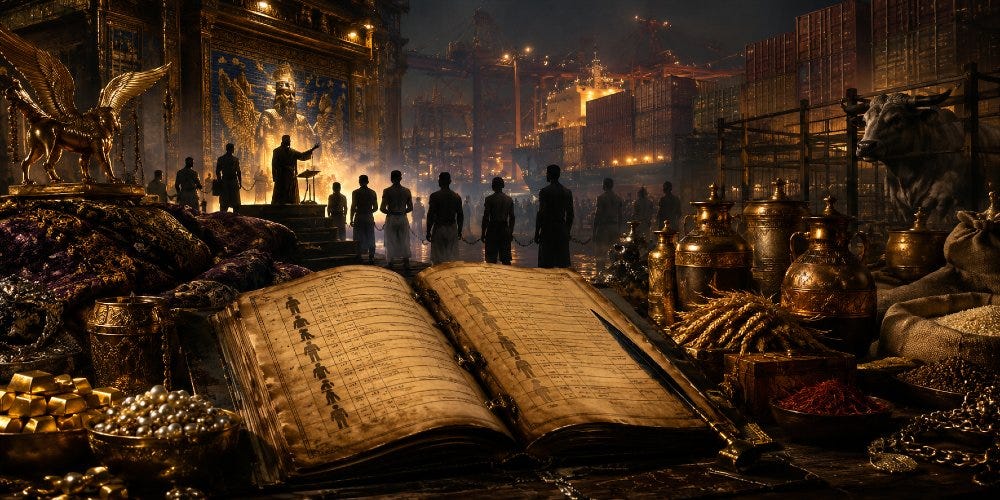
John’s list of Babylon’s cargo begins the way any inventory of a rich civilization begins. Gold, silver, precious stones, pearls. Then fine linen and purple and silk and scarlet. Then ivory, brass, iron, marble. Then the commodities of ordinary appetite, cinnamon and incense and ointment and wine and oil and fine flour and wheat. Then livestock, cattle and sheep. Then transportation, horses and chariots. And then, at the very bottom of the manifest, after the spices and the furniture and the freight, the last two entries.
And cinnamon, and odours, and ointments, and frankincense, and wine, and oil, and fine flour, and wheat, and beasts, and sheep, and horses, and chariots, and slaves, and souls of men.
The order is the argument. A civilization does not begin by selling people. It begins by selling metal and cloth, works its way through food and animals and transport, and arrives at human beings only when everything else has already been priced.
The Greek word rendered “slaves” is somaton, which simply means bodies, and it was the ordinary commercial term of the ancient world for a person you owned. What makes the verse land is that John did not stop there. He added a second category, souls of men, and commentators have argued for two thousand years about whether that phrase intensifies the first or names something worse.
We are in a position to answer that question, because four separate industries are currently running the experiment. None of them requires a prophecy chart to see. They require a search engine and the willingness to look at what the numbers actually describe.
The Ledger Nobody Disputes
Start with the least controversial number. The International Labour Organization, together with Walk Free and the International Organization for Migration, estimates that 50 million people were living in modern slavery in 2021, 28 million in forced labor and 22 million in forced marriage. That figure rose by 10 million in five years. Eighty-six percent of forced labor sits in the private sector rather than in state camps, and the annual illegal profit generated by it is estimated at $236 billion, of which roughly $172.6 billion comes from commercial sexual exploitation.
The detail that should stop a Western reader is geographic. More than half of all forced labor is found in upper-middle-income and high-income countries. This is not a problem confined to failed states and jungle mining camps. It is embedded in the supply chains of the wealthiest economies on earth, which is precisely the condition Revelation 18 describes.
Babylon is not poor. Babylon is the richest thing anyone has ever seen, and its merchants are the ones weeping when the market closes.
The Contract Read Out Loud
Chattel slavery required a legal category. What replaced it required only a legal instrument.
In May 2025, Arcadia police in Los Angeles County responded to a hospital report that a two-month-old had suffered a traumatic head injury. What they found led to 21 children being taken into protective custody, nearly all of them born to surrogate mothers scattered across the country, all of them traced to the same couple.
Guojun Xuan and Silvia Zhang did not merely hire an agency. Investigators determined that the children were the product of a surrogacy operation the couple themselves owned. Surrogates recruited through Facebook were shown a profile describing a family struggling to conceive a second child. They were not told that the intended parents ran the agency, or how many women were carrying at the same time.
The couple denies wrongdoing. They say they wanted a large family. No criminal charges have been filed. Zhang told the Wall Street Journal, “We never sell our babies.”
Take her at her word, and the case gets worse rather than better. Because when two surrogates in Virginia cut off contact and declined to hand over the newborns they had carried, Xuan and Zhang did not report a kidnapping. They filed suit for breach of contract, demanding custody of the infants and $1 million from each woman, against original agreements of $70,000 and $45,000 plus expenses. A million dollars in damages for failure to deliver.
That is the sentence worth sitting with. Not because anyone said the word “sale,” but because nobody had to. The transaction was already structured as one, and the remedy sought was the remedy any merchant seeks when a shipment does not arrive.
And they have cast lots for my people; and have given a boy for an harlot, and sold a girl for wine, that they might drink.
Joel was not describing a black market. He was describing casual commerce, the kind conducted by people who would be genuinely offended at being called traffickers.
Tyre Kept the Same Books
Revelation 18 is not the first cargo manifest in Scripture. Ezekiel 27 runs an almost identical list against Tyre, the commercial superpower of its day, itemizing silver and iron and tin and lead, ivory and ebony, emeralds and coral, wheat and honey and oil, lambs and rams and goats. And in the middle of that inventory sits the thirteenth verse.
Javan, Tubal, and Meshech, they were thy merchants: they traded the persons of men and vessels of brass in thy market.
Persons of men and vessels of brass, listed together, priced by the same clerk. John was not inventing a new indictment. He was telling his readers that the pattern they knew from Ezekiel would run one final time, at maximum scale, at the peak of human commercial achievement. Which raises the uncomfortable question of what has actually changed since Tyre. The technology improved. The paperwork got better. The moral logic is identical, and so is the self-congratulation of the merchants.
A Market Built on Prisoners
In May 2025, the House of Representatives passed the Stop Forced Organ Harvesting Act by a vote of 406 to 1. Foreign Affairs Committee chairman Brian Mast argued on the floor that “The human body is not a currency. It’s not a commodity.”
The lone dissenting vote came from Rep. Thomas Massie, which is worth noting for anyone who has mistaken procedural purity for principle.
The bill’s sponsor, Rep. Chris Smith, has described an industry that treats the human body as inventory and generates as much as $1.7 billion annually. The China Tribunal, an independent panel that reviewed evidence over twelve months, concluded that state-sanctioned forced organ harvesting of prisoners of conscience amounts to crimes against humanity. Nine United Nations special rapporteurs have called on Beijing to answer the allegations. Estimates of scale vary widely and remain difficult to verify, which is exactly what a regime with no transparent donor registry and no independent hospital access would prefer.
More than a year after that 406 to 1 vote, the Senate companion has still not become law. It cleared the Foreign Relations Committee in June 2026 and was reported to the full Senate in late July. Sanctioning people who kill prisoners for their kidneys polls at roughly 100 percent, and it still cannot get floor time. An earlier version died in the same committee without a vote.
Then there was the microphone. On September 3, 2025, walking toward the reviewing stand at a military parade in Beijing, Xi Jinping and Vladimir Putin were overheard on a livestream carried by China’s own state broadcaster. Putin’s translator was heard saying that human organs can be continuously transplanted, that a person grows younger the longer he lives, that immortality is conceivable. Xi replied that some predict humans in this century may live to 150. Putin confirmed the exchange to reporters afterward. The broadcast drew 1.9 billion views online.
Set aside the futurism. Notice the assumption underneath it. A supply of replacement parts is taken for granted by the two men least likely to be asked where it comes from.
The Part Where We Cannot Point East
It would be convenient to file all of this under foreign atrocity. Revelation does not permit that exit, because the last item on the manifest is not bodies. It is souls of men, and the difference matters.
According to its parent company’s own corporate filings, OnlyFans processed $7.22 billion in gross fan payments in fiscal 2024, across 377.5 million fan accounts and 4.63 million creator accounts. No trafficker recruited most of those creators. They signed up. And the average one earns roughly $131 a month, which means the overwhelming majority sold something irrecoverable for the price of a phone bill while a fraction of one percent took the actual money.
That is a market in souls of men operating entirely on consent, and consent turns out not to be the moral firewall the culture assumed it was. A civilization can arrive at the bottom of Babylon’s manifest without a single slave ship, simply by convincing enough people to list themselves.
Why the Merchants Weep
The most damning line in Revelation 18 is not the inventory. It is the reaction. When Babylon falls, the merchants of the earth weep and mourn, and the text is explicit about why. No man buyeth their merchandise any more. Not one of them grieves for the people on the list. They grieve for the market.
Whether Revelation 18 is describing first-century Rome, a future system, or the recurring character of every commercial civilization that outlives its conscience, the diagnostic value is the same. Scripture predicted that human beings would eventually be entered into the ledger, priced against wheat and cattle and freight, and that the men holding the ledger would be sincerely bewildered at the suggestion they had done anything wrong.
That prediction is no longer waiting on events. It is waiting on someone to read the manifest out loud.
Is it possible that America is the end-times "Babylon the great"?
America fits all of the Biblical parameters; which no other nation does.
The best video I know on the subject, a classic in the prophetic field:
WhyAmericaIsBabylon.com