

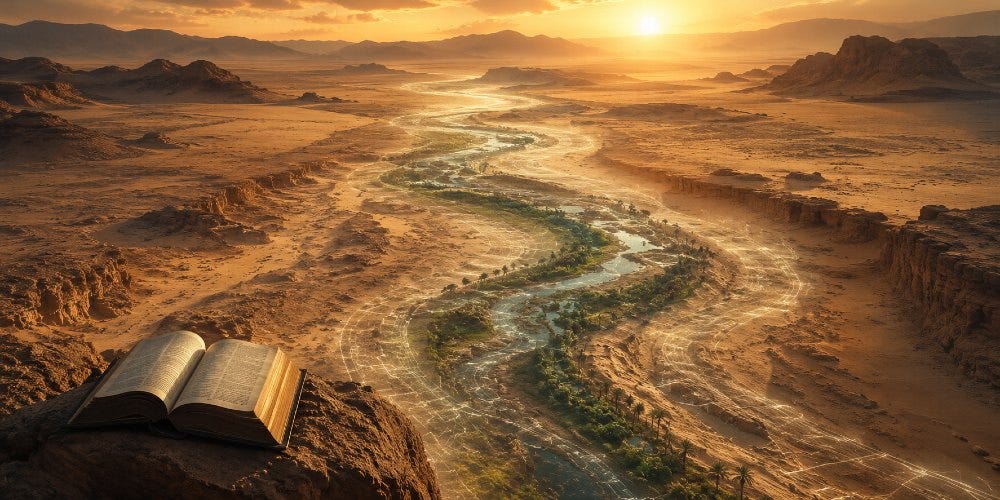
For six thousand years, skeptics have treated the opening chapters of Genesis as a collection of pious folklore, a set of bedtime stories dressed up in the language of geography. Then space-age radar pointed straight at one of those “stories” and found it buried under the sands of Arabia.
The Pishon River, one of the four waterways Scripture says flowed out of Eden, appears to have left a fossil signature in the earth that matches the biblical text with uncomfortable precision. The question worth asking is not whether the Bible got lucky, but why anyone ever assumed it would be wrong.
The account in Genesis is specific in a way that fiction rarely bothers to be. A single river flowed from Eden and divided into four heads, named the Pishon, the Gihon, the Hiddekel, and the Euphrates.
Two of those names belong to rivers any schoolchild can locate on a map. The Tigris and Euphrates still run through modern Iraq, carrying their ancient identities largely intact. The Pishon and Gihon, however, slipped out of human memory long ago, which gave critics a convenient opening. If two of the four rivers could not be found, the entire passage could be filed away as myth.
That assumption held until technology caught up with the text. In the early 1990s, Boston University geologist Farouk El-Baz examined radar images captured by NASA’s Space Shuttle Endeavor, and what the instruments revealed was a long, dry riverbed snaking across northern Arabia. The channel, known as the Wadi al-Batin, runs from the Hijaz mountains of western Saudi Arabia down through Kuwait toward the head of the Persian Gulf. Biblical archaeologist James A. Sauer studied the same imagery and concluded that this dead river fit the description of the Pishon more closely than any other candidate ever proposed.
The fit is not vague. Genesis says the Pishon “compasseth the whole land of Havilah, where there is gold,” and adds that the gold of that land is good, along with bdellium and onyx stone. The region the Wadi al-Batin drains is precisely the part of the Arabian Peninsula associated with gold and semiprecious stones.
A book supposedly written by primitive desert dwellers managed to name the mineral wealth of a riverbed that would remain invisible to human eyes until a spacecraft photographed it from orbit. One wonders how the authors of mythology came by such accurate geology.
None of this should surprise anyone who takes the text at its word. The river drained more than forty thousand square miles of territory during a wetter climatic era, then dried into the buried channel that satellites would later trace. The water disappeared, the name faded from the maps, and the modern academy concluded that what it could no longer see had never existed. That is the recurring conceit of the secular mind, the assumption that the limits of present knowledge mark the limits of reality.
The Pishon did not stop being real when men forgot it. It simply waited.
“And a river went out of Eden to water the garden; and from thence it was parted, and became into four heads.”
There is a lesson buried in that dry channel that goes well beyond hydrology. Scripture has been declared discredited, outdated, and mythological in nearly every generation, usually by people confident that the latest scholarship had finally buried it. And in nearly every generation, the spade or the satellite eventually turns up something that the Bible quietly recorded all along.
The land that “compasseth Havilah” was not invented to fill a gap in a story. It was reported, like a journalist reports a fact, by men who evidently believed they were describing a real world. The faith of the patient is not the credulity of the foolish, as the word reminds us: “For we walk by faith, not by sight.”
The discovery proves nothing about Adam, Eve, or the moral architecture of the Fall, and honest believers should not pretend otherwise. What it does is shift the burden. For two centuries the cultured despisers of religion have insisted that the burden of proof rests entirely on the faithful, that every biblical claim is guilty until excavated. Yet here is a river that the text named, that critics dismissed, and that the hardest of hard sciences eventually located in the ground. At some point the pattern stops being coincidence and starts being a track record.
So the next time a documentary narrator intones that Genesis is a beautiful collection of legends, it is fair to ask which part. The part that named two rivers everyone can still find, or the part that named a third one that vanished for six thousand years and then turned up exactly where the book said it would. The Pishon ran dry a very long time ago. The text that remembered it has not.
Trump, Vance go out of their way to reward Iran and trash Israel. He came to the rescue of Hamas leaders in Qatar, even threatening Israel. He came to the rescue of Hamas in Gaza City, their last stronghold with his bogus ceasefire when the IDF was going to finish them off. Now he rescued Hezbollah in Lebanon which was never part of the deal.
Trump never trashes Pakistan, Turkey, Qatar, Egypt, Saudi Arabia like he does Israel.
Follow the $.
I sure hope Israel wakes up to nefarious and duplicitous, backstabbing USA that cause the Gaza War with it's counterfeit peace Road Map used to weaken and control Israel.
@JD Rucker how come you haven’t spoke out about the ongoing mRNA genocide? God is taking the dollar and if the US doesn’t repent after that war will breakout. He will destroy the United States for all the bloodshed.
I had a vision in February last year, I was sitting down when someone jabbed me in the arm. I then heard,”ouch you son of a bitch you bit me.” Everything started to shake and when I woke up I saw an open vision of the US dollar.
I had another dream last year. I was falling asleep against a wall in a messianic synagogue, when one of the elders said,”Shawn if you are falling asleep come closer.” I got halfway to the alter when I was slay in the spirit—I started yelling,”war”. When I hit the deck I went into a vision and saw the planets align and come out of alignment.