
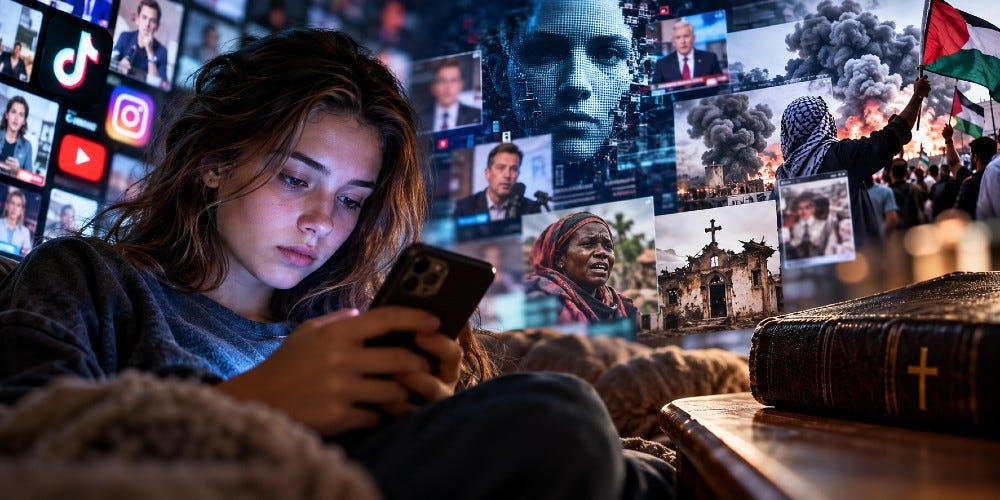
Bethany Miller is not warning about some future problem. She is describing the one already sitting in your pocket.
The communications director for the National Religious Broadcasters told Faithwire and CBN News that believers are walking into an information war with the habits of people who still think the news comes from a desk at 6 p.m. It does not. Social media is how young and old alike get their headlines now. Reels. Clips. A stranger with a ring light and a confident voice. Then artificial intelligence on top of that, manufacturing footage that looks real enough to fool a generation that never learned the difference.
New media is something we shouldn’t be afraid of. We need to stay ahead of the curve and realize new media is the way. Social media is how we get our headlines.
That part is true. Fear of the tool is a lazy excuse. The tool is already the public square. Pretending otherwise does not keep your kids out of it. It just means somebody else catechizes them there.
A Generation With No Wall Between the Screen and the Street
Miller’s sharper point is about Generation Z and teenagers. They are growing up with no separation between the digital world and the physical one. Information lands, and the first question is no longer whether it happened. The first question is whether it feels true.
Today’s Gen Z’s and teenagers are growing up without any form of separation between the digital and the physical. And so information is being consumed and then the tricky part is now we’re having the question of what is real and what is not real.
That is not a parenting lecture. That is a description of the battlefield. Inaccurate headlines. Everybody’s opinion, delivered at the same volume as a fact. Truth and untruth stacked in the same scroll until the eye stops trying to sort them. Miller said Gen Z has not grown up with any distance between reality and what is not reality, and she does not think they have the discernment to ask whether a clip is true, whether it is biblical, or whether it is true, good, and beautiful.
Scripture already named this problem. “Beloved, believe not every spirit, but try the spirits whether they are of God because many false prophets are gone out into the world.” The false prophets used to need a pulpit or a printing press. Now they need a prompt and a thumbnail.
Random video is not testimony. An AI voice reading a Bible verse in a dead pastor’s cadence is not a word from the Lord. A thirty-second clip of a war, cropped to flatter one side, is not the war. Miller said the assumption that those things are authentic is already producing a pile of confusion, and she is right. The American public is drinking from a firehose of headlines and calling the spray news.
The Stories the Feed Buries
This is where the argument stops being about media literacy and starts being about souls and nations.
Miller pointed at two examples that ought to embarrass every newsroom still pretending it covers the world evenly. Persecution of Christians in Nigeria barely registers. After Hamas slaughtered Israelis on October 7, Israel was the one put on trial in a thousand clips. The bodies were real. The framing was a choice.
Fox News has already carried the Nigeria numbers that polite television prefers to skip. Bill Maher, of all people, said Islamists have killed more than 100,000 Christians there since 2009 and burned some 18,000 churches, and that more Christians are killed for their faith in Nigeria than in the rest of the world combined. Open Doors has said the same thing for years. The feed did not. A generation that gets its headlines from Reels can recite Gaza talking points and cannot find Plateau State on a map.
That is information warfare. Not a metaphor. A selection. What gets thirty seconds of outrage, and what gets silence, trains the conscience. If the church is not in that fight, the silence wins by default.
The Great Commission Did Not Stop at the Shore
Miller’s answer is not retreat. Christian media, she said, is finally getting better across social platforms, film, and television. There is still a long way to go. Creators have to know the audience. Thirty seconds is what performs on Instagram. Format is not compromise if the truth survives the cut. It is competence.
We know that Christian media has the answer, we have truth, we are the only ones that are providing the way to eternity.
That last line will irritate people who want faith kept in a private drawer. Good. The way to eternity is not a brand position. It is the claim. If it is true, then a feed full of half-true war clips and synthetic sermons is not a hobby. It is a mission field.
When we talk about the Great Commission, that doesn’t just mean going over across seas to Africa. It also means getting online because the mission field is also media. It is also digital.
And then the line that should end the argument about whether believers belong there at all.
The digital world is a spiritual world as well and Christians need to be there combating, and we need to be there leading the front lines, and we need to be there getting the truth.
Leading is not reposting. Leading is telling the Nigeria story when the algorithm will not. It is refusing to let October 7 be rewritten by the loudest editor on the app. It is teaching a teenager to ask who made the clip, what it cut out, and whether it agrees with the Word before it agrees with the vibe.
New media is not the enemy. A church that fears the tool and abandons the field is. The war is already on. The only open question is whether the people who have the truth plan to show up.