

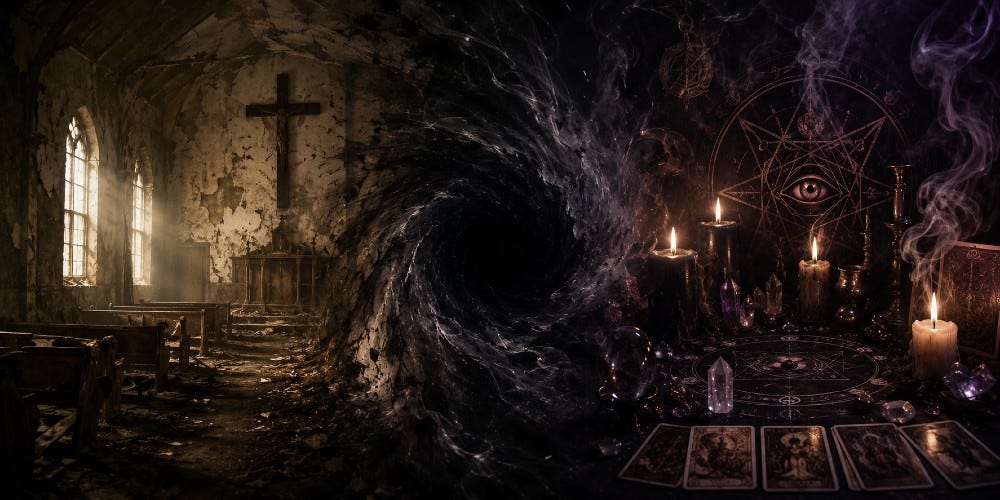
As authentic Biblical Christianity recedes in the West, a dark substitute rushes in to fill the void. What many dismiss as harmless trends in astrology, tarot, and witchcraft represents something far more serious: a spiritual hunger gone awry, where souls adrift from the God of Scripture seek meaning in forbidden realms. This shift is no mere cultural curiosity but a predictable consequence of abandoning transcendent truth for self-centered spirituality.
The evidence surrounds us. Churches increasingly prioritize emotional experiences over doctrinal soundness, while a growing segment of the population turns to the occult for guidance. This pattern echoes ancient warnings about the human heart’s inclination toward idolatry when cut off from its Creator. Far from progress, this turn signals a regression into the very superstitions Christianity once displaced in the West.
Arguably the saddest part is many who get involved with the occult do not even understand what occultism is or why it is eternally destructive.
Statistics paint a sobering picture of the transformation that’s happening, particularly in Western culture. With Biblical worldview adherence plummeting even among self-identified Christians, the door stands wide open for deceptive spiritual alternatives.
A Predictable Spiritual Consequence
When Biblical Christianity weakens, the vacuum does not remain empty. Humanity bears an innate drive toward the transcendent, implanted by God Himself. Reject the true and living God, and lesser powers eagerly step forward. This dynamic explains the remarkable rise of “WitchTok” and pagan influencers who package ancient occultism as empowerment and self-discovery.
Paul’s words to Timothy ring with fresh relevance: perilous times emerge when people love pleasure rather than God, maintaining a form of godliness while denying its power. Modern Western culture exemplifies this peril. Secularism promised liberation from religious constraints, yet it delivered widespread anxiety, purposelessness, and moral confusion. Into this void step the occult’s false promises of control, hidden knowledge, and personal divinity.
The Role of Compromised Churches
Too many congregations have contributed to this crisis by diluting Scripture. Sermons that rarely mention sin, repentance, or spiritual warfare leave believers unequipped for the battles they face. When churches emphasize psychology, mysticism, or cultural relevance over the full counsel of God, congregants naturally drift toward other sources for supernatural encounter.
This syncretism proves especially dangerous among younger people. Raised in environments where truth is fluid and feelings reign supreme, many blend Christian language with occult practices, seeing little contradiction. Yet Scripture draws sharp boundaries. Deuteronomy and other passages explicitly forbid consulting mediums, astrologers, or engaging in witchcraft—practices that invite demonic influence rather than divine blessing.
Cultural Normalization and Its Dangers
Popular entertainment accelerates the trend. Streaming services, music, and social platforms flood minds with occult imagery, portraying demons and spells as empowering or entertaining. What previous generations recognized as dark now receives celebration as “diverse spirituality.” This desensitization opens doors that are difficult to close.
The irony would be comical if it wasn’t so damning. A society that mocks Biblical warnings about spiritual deception eagerly embraces doctrines of demons. While dismissing the Bible as outdated mythology, many flock to horoscopes and crystals for daily direction. This contradiction exposes the emptiness of secular humanism: it cannot satisfy the soul’s deepest longings.
Believers who stand firm face increasing cultural pressure. Yet history shows that faithful remnants preserve truth amid widespread apostasy. The current darkness may represent not defeat but the prelude to greater spiritual clarity as lines between light and darkness grow more distinct.
Jesus warned of deception increasing in the last days. The rise of occult interest amid declining Biblical faith confirms this trajectory. Rather than panic, Christians must respond with renewed commitment to sound doctrine, fervent prayer, and bold proclamation of the Gospel.
Ephesians 6:12, which I rightly quote often, reminds us of the real nature of our struggle: “For we wrestle not against flesh and blood, but against principalities, against powers, against the rulers of the darkness of this world, against spiritual wickedness in high places.”
Recognizing this reality equips the Church to stand against encroaching darkness.
“And they overcame him by the blood of the Lamb, and by the word of their testimony; and they loved not their lives unto the death.” (Revelation 12:11)
The West’s spiritual crisis presents both warning and opportunity. As occult practices proliferate, the Church must shine as a beacon of uncompromised truth. The same God who foretold these developments also promises ultimate victory through Christ. The question remains whether enough will heed the call before greater darkness descends.
My hand-picked, curated news site sourced from hundreds of trusted souls is one of the few places you can find stories that cover politics, culture, and Biblical faith. Please check it out and share it: jdrucker.com
Faith is belief without evidence and rationality. Religion elevates stupidity and ignorance to the level of virtue. I don't believe in heaven and hell. I'm not Christian. I don't believe in a god... or the devil. Of course, the rise in these other phenomena could more accurately be described as to the destruction of empirical thinking and associated education and schools/universities. People are getting stupider (lacking intelligence) and dumber (more ignorant; lacking knowledge/data/facts) by the generation. That is the answer to what is happening.
Anyone noticed ? America is cursed and headed to hell, no Golden Age delusion. Psalm 9:17 kjv.
Trump, Vance go out of their way to reward Iran and trash Israel. He came to the rescue of Hamas leaders in Qatar, even threatening Israel. He came to the rescue of Hamas in Gaza City, their last stronghold with his bogus ceasefire when the IDF was going to finish them off. Now he rescued Hezbollah in Lebanon which was never part of the deal.
Trump never trashes Pakistan, Turkey, Qatar, Egypt, Saudi Arabia like he does Israel.
Follow the $.
I sure hope Israel wakes up to nefarious and duplicitous, backstabbing USA that cause the Gaza War with it's counterfeit peace Road Map used to weaken and control Israel.