
Most of us wait until the danger has passed before we get generous. We call it prudence. Scripture has a harder word for it. It is unbelief dressed up as budgeting.
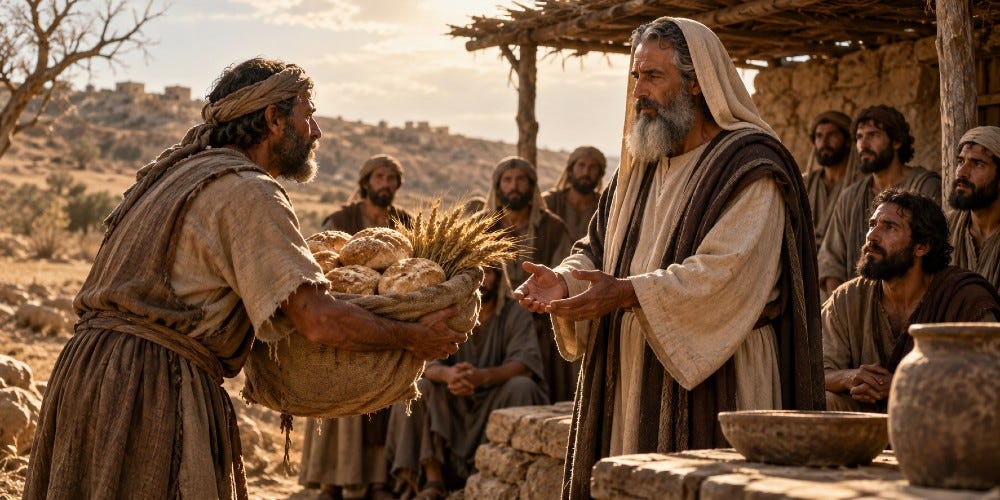
A Joni and Friends devotion sent readers back to a nameless man from Baalshalisha in 2 Kings 4. The land was in famine. The sons of the prophets were sitting with Elisha at Gilgal. A pot of stew had already nearly poisoned the company. Then this farmer walks in with twenty barley loaves and a sack of fresh ears of grain. Firstfruits. The first and best of a harvest that should not have existed.
He did not bring leftovers after the family was fed. He brought the portion that belonged to God while the country was still hungry.
And there came a man from Baalshalisha, and brought the man of God bread of the firstfruits, twenty loaves of barley, and full ears of corn in the husk thereof. And he said, Give unto the people, that they may eat.
Elisha did not stash it. He did not thank the man and send him home with a receipt. He told his servant to feed a hundred men with what would barely have covered twenty. The servant did what servants still do. He ran the numbers.
What, should I set this before an hundred men?
That is the voice of every church committee, every household budget, and every Christian who has ever said he will give more once things settle down. The math was not wrong. Twenty barley cakes for a hundred mouths is a short meal. Barley was the poor man’s grain, sometimes animal feed. The problem was not the arithmetic. The problem was who the servant thought was doing the feeding.
Elisha answered with a word from the Lord. They shall eat, and shall leave thereof. The servant set the bread down. They ate. They had leftovers. The text is almost blunt about it. It happened according to the word of the Lord, not according to the size of the sack.
Firstfruits Are Not a Tip
Under the Law, firstfruits belonged to God and were given to the priests. In the northern kingdom the Levitical system had already collapsed. Faithful Israelites still had to decide whom they would treat as the Lord’s representative. This man brought his offering to the prophet. That was not a loophole. It was loyalty. While Baal’s name sat on his hometown, he carried bread to the man of God.
Firstfruits were never about agriculture as such. They were a public confession that the field, the rain, and the next harvest all belonged to Someone else. You gave the first because you trusted Him for the rest. You did not wait to see whether the rest would come.
That is why the later feasts keep pressing the same point. Israel waved firstfruits after Passover. Christ rose on that feast as the firstfruits of them that slept, a connection Harbinger’s Daily has drawn with the rest of the spring calendar. The pattern is older than our offering envelopes. God takes the first. Then He proves He can keep His people alive on what remains.
Centuries later a boy handed Jesus five barley loaves and two fish. The disciples asked the same question Elisha’s servant asked. The Christian Post has noted how cheap that barley lunch would have looked to a crowd. Christ blessed it anyway. Thousands ate. Twelve baskets came back. The God of Elisha had not changed His method. He still multiplies what is placed in His hands first.
Leftover Religion
We live in the opposite spirit. Americans have been shrinking their charity for years, and economic fear only accelerates the reflex. Give after the bills. Give after the vacation. Give if anything is left. A Gallup finding reported by Fox News already showed faith sliding out of daily life for half the country. When God is no longer first in the heart, He will not be first in the wallet, the calendar, or the attention span.
The Joni and Friends line is the right one. Giving God the first portion is not generosity. It is a declaration. You are saying He is your source, not your surplus.
Joni Eareckson Tada has lived that sentence with a body the world would call a deficit. After the diving accident, the wheelchair, the decades of pain, she kept offering what she had. CBN recorded her calling those years “small moments of drastic obedience.” Wheelchairs went out. Bibles went with them. The ministry did not wait for ease. It treated a broken life as firstfruits and watched the Lord make it feed more people than the original offering could explain.
That is the scandal of this little story. The famine did not end before the gift was given. The hundred were not a manageable crowd. The bread was not impressive. Faith moved first. Provision followed.
But seek ye first the kingdom of God, and his righteousness; and all these things shall be added unto you.
The unnamed man from Baalshalisha will not be remembered for his yield or his name. He will be remembered because he refused to treat the Lord like a leftover. Twenty loaves walked into a famine. A hundred men walked out full. The only thing that stretched was the word God had already spoken.
The question is not whether you have enough. The question is whether the first piece still belongs to Him.
Important note: This type of story is often used by preachers of the “prosperity gospel” to get poor people to donate all they have. Be discerning about who receives your gifts as not all are used on behalf of God.
"Full ears of corn in the husk thereof"
The interesting thing here is, corn is native only to Mesoamerica (now Mexico) It was domesticated and bred from a wild grass called teosinte. "All maize (corn) arose from a single domestication in southern Mexico about 9000 years ago." Wikipedia
Corn cobs have been discovered in the tombs of ancient Egyptian kings.
We sure seem to be satisfied with defective history.
Curse the root, lose the fruit. Bless the root, the fruit comes naturally. This isn't superstition - it's how covenants work.