

There is a zoning fight unfolding somewhere in America right now. A church wants to expand its parking lot. A neighbor objects. A council debates. A pastor adjusts his sermon.
It looks like nothing. A small administrative quarrel, the kind that fills the back pages of local papers and the calendars of city clerks. But pull the camera back. Pull it back further. Keep pulling until you see the whole picture — the school board hearings, the licensing rules, the chaplaincy disputes, the speech codes, the platform bans, the curriculum fights, the marriage redefinitions, the gender ideologies imposed on children, the pandemic-era closures that locked sanctuaries while liquor stores stayed open. Pull back until you see every front at once.
Now ask: what is the one thing that, across every battle, is being slowly squeezed?
It is the freedom — and frankly the will — to live as a Christian.
The claim, stated plainly
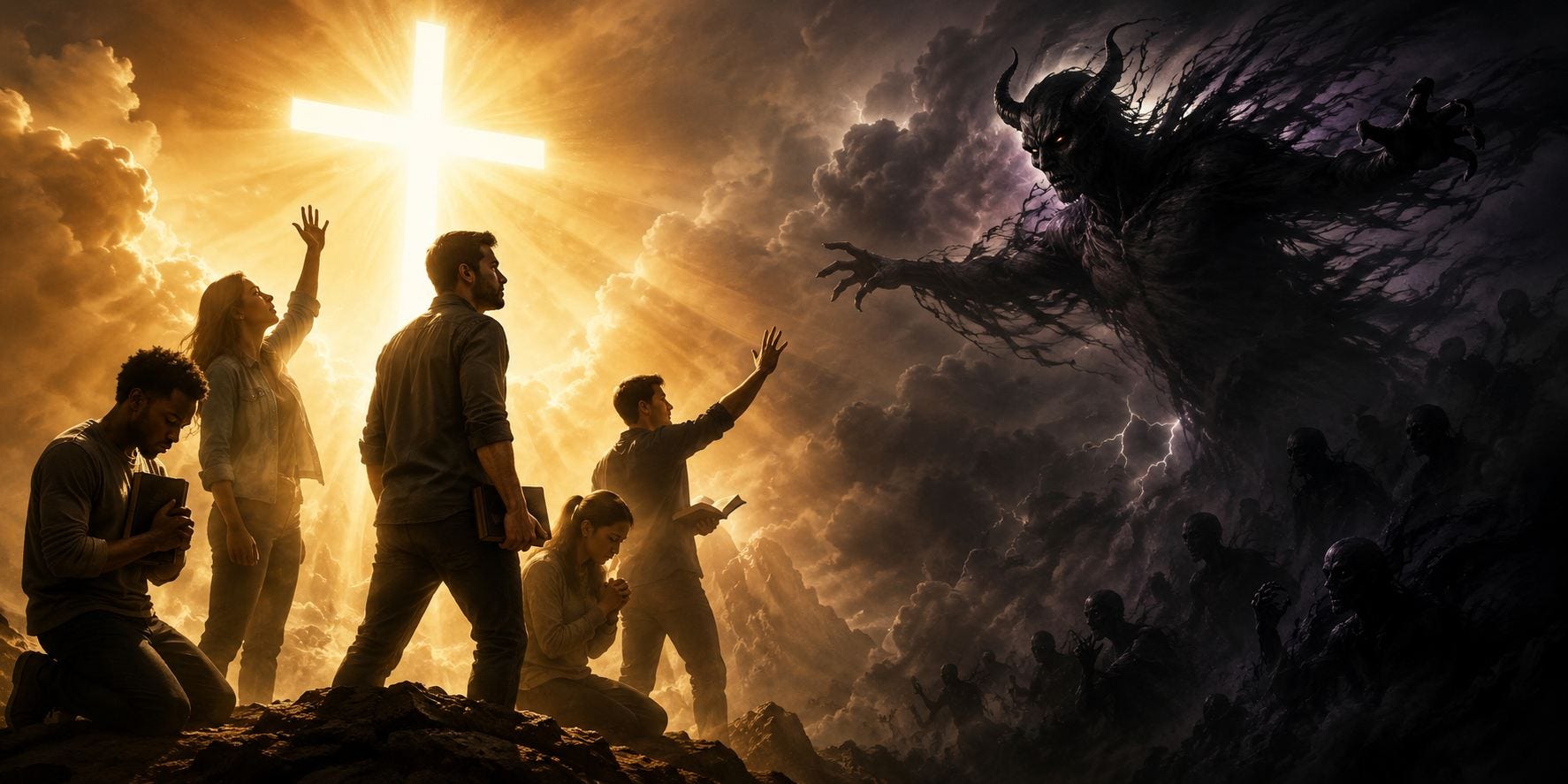
Every political and cultural battle we are facing is, at root, part of a single spiritual war. Not most. Not the obvious ones. Every one.
That sounds extreme. It is meant to. Because the moment you concede that some battles are merely material, merely about tax brackets, merely about zoning, merely about which bathroom or which pronoun or which curriculum, you have already given the adversary the territory he wanted.
He does not need every fight to be a frontal assault on the Cross. He only needs enough of them to feel ordinary. Distraction is a weapon. Fatigue is a weapon. The slow normalization of small surrenders is a weapon. Paul did not say our wrestling was sometimes against principalities and powers. He said in Ephesians 6:12, “we wrestle not against flesh and blood, but against principalities, against powers, against the rulers of the darkness of this world, against spiritual wickedness in high places.”
Every wrestling match. Every one.
Why it has accelerated
A fair question is why this seems more intense now. Hasn’t every Christian generation thought it was the last? Tertullian thought so. The Reformers thought so. The Puritans thought so. Every century produces its prophets of imminence, and most of them have been wrong about the timing.
But being wrong about timing is not the same as being wrong about direction. And the direction since 2020 is not subtle.
Consider what changed during and after the pandemic. Churches were closed by government order while other gatherings were deemed essential. The mechanisms of digital life, already corrosive to attention, community, and chastity, were accelerated by a decade in eighteen months. Institutional trust collapsed across the board, including trust in churches that complied too readily and trust in churches that resisted too loudly. Ideologies that had been confined to faculty lounges flooded into kindergarten classrooms, corporate HR departments, and medical guidelines. The line between public health and public conscience was redrawn unilaterally. And the speed of all of it is the tell.
Daniel was told that in the time of the end, “many shall run to and fro, and knowledge shall be increased” (Daniel 12:4). Read that with twenty-first-century eyes. We do not merely have more information; we have more information than any human nervous system was designed to metabolize, arriving faster than we can pray about it, weaponized by algorithms that profit from our agitation.
The increase of knowledge has not produced wisdom. It has produced exhaustion. And exhaustion is exactly the spiritual condition in which faith is most easily eroded.
The mechanism
How does a spiritual war manifest in a school board meeting? In a tax code? In a software platform’s content policy?
It does so the way Lewis described in The Screwtape Letters — not by frontal assault but by drift. A thousand small redirections. A culture in which prayer in public feels embarrassing. A workplace in which mentioning your faith is a career risk. A platform that throttles certain words. A curriculum that treats biblical sexuality as bigotry. A pediatric guideline that overrides parental conscience. A pandemic protocol that treats corporate worship as optional and casino floors as essential.
None of these, taken alone, is the Beast. That is the point. Taken together, they form a slow pressure on the believer’s life — pressure to attend less, pray less, witness less, suffer less for the Name, and eventually to wonder whether the Name itself was ever worth the trouble. The adversary does not need to make Christianity illegal. He only needs to make it expensive, exhausting, and embarrassing.
He has been remarkably successful.
The secular counter and why it is itself a weapon
The thoughtful secular response runs like this: what you call a spiritual war is more simply explained as secularization. Western societies have been drifting from Christian assumptions for two and a half centuries. The post-Covid acceleration reflects institutional collapse and generational turnover, not metaphysical conflict. Every previously dominant religion feels besieged when its cultural privilege fades. Your “spiritual war” is just status grief in theological clothing.
It is a serious argument. It deserves a serious answer.
But notice what the argument requires you to accept first: that the material explanation is sufficient. That there is no unseen realm bearing on the seen one. That Paul was speaking metaphorically and Daniel was speaking poetically and the prince of Persia who delayed Gabriel for twenty-one days (Daniel 10:13) was a literary flourish.
The secular counter is not neutral analysis. It is a metaphysical claim — the claim that the visible exhausts the real. That claim is itself one of the adversary’s most useful instruments, because a believer who accepts it has already disarmed before the battle begins. You cannot put on the whole armor of God if you have been persuaded the armor is decorative.
This does not mean every secular critic is demonic, or that every Christian instinct is correct. It means the framework that dismisses the spiritual dimension is not a view from nowhere. It is a view from somewhere, and that somewhere has a long history in scripture, going back to a garden and a question: Hath God said?
The in-house warning
Here is where many pieces like this one go wrong, and where I want to be careful.
The claim that every cultural battle is spiritual can become a license for tribalism dressed in robes. It can baptize political coalitions as righteous and political opponents as demonic. It can confuse losing cultural privilege with losing the faith. It can produce Christians known for what they are against rather than Whom they are for.
Peter drew the line sharply: suffering for righteousness is blessed, but suffering “as a busybody in other men’s matters” is not (1 Peter 4:15-16). Not every Christian grievance is persecution. Some of it is just rudeness with a fish bumper sticker.
The spiritual war is real. The Christian who weaponizes that reality to justify his own pride is fighting on the wrong side without realizing it. The early church grew under genuine persecution because Christians out-loved, out-served, and out-suffered their neighbors. They did not seize cultural power. They were salt and light precisely where they had no power at all.
So when I say every battle is spiritual, I am not saying every self-proclaimed Christian is right. I am saying the stakes are higher than the headlines admit, and that includes the stakes of how we fight.
What to do now
This is where Jude is essential. His short letter is written to believers in exactly our situation, surrounded by drift, infiltrated by teachers who turned grace into license, watching faithfulness erode in real time.
He does not tell them to panic. He tells them to remember. To contend earnestly for the faith once delivered. To build themselves up in their most holy faith, praying in the Holy Spirit, keeping themselves in the love of God, looking for the mercy of our Lord Jesus Christ. And then this, the line that should be carved over every Christian’s desk in this season: “And of some have compassion, making a difference: and others save with fear, pulling them out of the fire” (Jude 22-23).
Compassion. Difference. Rescue.
Do not live in fear. Your salvation is secure; the One who began a good work in you will complete it. But do not underestimate either the adversary or your own weakness. The same Jude who tells you to contend ends with the doxology that anchors everything: “Now unto him that is able to keep you from falling, and to present you faultless before the presence of his glory with exceeding joy” (Jude 24).
He is able. You are kept. The war is real, and the outcome is not in doubt.
But the front line runs through your Monday morning — through what you give your attention to, what you tolerate, what you teach your children, what you refuse to laugh at, what you are willing to lose for the Name. Every battle. Every one. The adversary is counting on you not noticing.
Notice.