

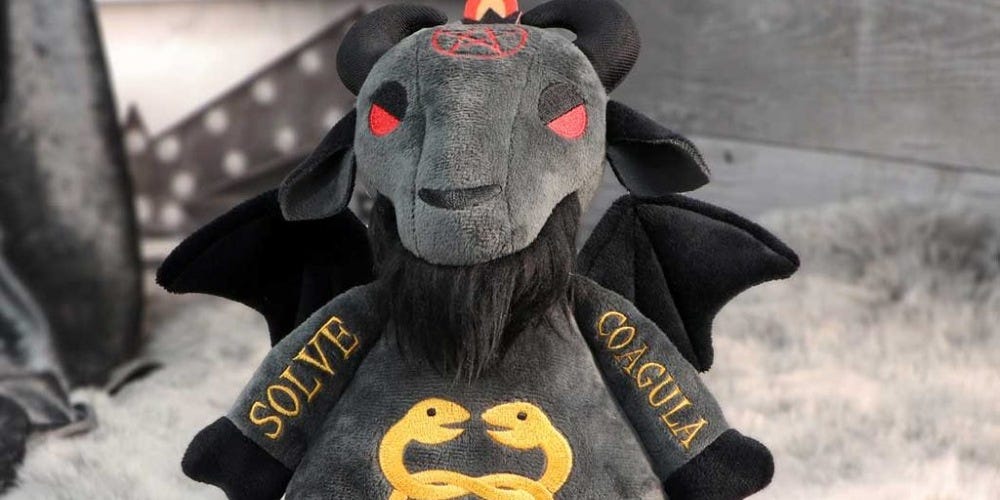
A goat-headed figure with horns, wings, and a human body sits on store shelves as a soft, huggable plush. Kids see an adorable stuffed animal. Christian parents should see what the symbol actually is.
Baphomet did not begin as a cartoon character. The image took shape in nineteenth-century occult circles and was later claimed by Satanic groups. Christianity.com reports that companies like Squishable now sell soft versions with playful copy that treats the figure as a chill companion for tea and heavy metal. The packaging is cute. The history is not.
Making something soft does not rewrite its meaning. Making it funny does not make it spiritually neutral. A child lacks the categories to know the difference. That is why parents exist.
When Darkness Arrives as Entertainment
The plush toy is only one example of a larger pattern. Ideas Scripture calls detestable have been rebranded as harmless fun.
Astrology is the clearest case. Horoscopes appear in magazines, social feeds, and casual conversation. “What’s your sign?” no longer raises an eyebrow. A 2025 Pew Research Center survey found that 28 percent of American adults consult astrology or a horoscope at least once a year, and 30 percent consult astrology, tarot cards, or a fortune teller on that same schedule. Most call it entertainment. Scripture does not grant that exemption.
The Ouija board followed the same path. It left the Spiritualist parlor and entered the game aisle. Its premise remains an attempt to contact spirits.
Deuteronomy 18:10-12 is blunt: “There shall not be found among you any one that maketh his son or his daughter to pass through the fire, or that useth divination, or an observer of times, or an enchanter, or a witch, Or a charmer, or a consulter with familiar spirits, or a wizard, or a necromancer. For all that do these things are an abomination unto the LORD.”
Leviticus 19:31 adds the same warning against mediums and spiritists. The issue is not cultural taste. It is spiritual allegiance. God alone supplies wisdom, guidance, and truth. Turning elsewhere breaks that bond.
What a Clean Break Looks Like
The New Testament does not soften the line. Paul told the Corinthians that pagan sacrifices are offered to demons and that believers cannot drink the cup of the Lord and the cup of demons. Ephesus was thick with sorcery. When the gospel took root, those who had practiced magic brought their scrolls and burned them in public. The value of the books was fifty thousand drachmas—a fortune. They did not keep a few as curiosities. They made a clean break because they knew what the scrolls represented.
Saul shows the opposite path. He had driven mediums out of Israel. He knew the command. When the Philistines pressed him and the Lord gave no answer, he disguised himself, traveled by night, and consulted the medium at Endor.
First Chronicles 10:13-14 records the verdict without apology: Saul died because he was unfaithful to the Lord, did not keep His word, and consulted a medium rather than inquiring of God. Each earlier compromise had made the next one easier.
What we laugh at we learn to tolerate. What we tolerate we learn to accept. What we accept we eventually practice. Culture is comfortable with darkness dressed as fun. Families must be clearer than the culture.
Teaching Discernment Without Fear
Biblical illiteracy makes the work harder. Hosea 4:6 still applies: people are destroyed for lack of knowledge. Children are drawn to color, story, and novelty. Their innocence is not the problem. The problem is parents who have never trained them to test what they see against Scripture.
Hebrews 5:14 says the mature have trained themselves by constant use to distinguish good from evil. That training does not come from one viral warning or a single ban. It comes from sustained time in the Word. Romans 12:2 calls believers to refuse the world’s pattern and be transformed by the renewing of the mind. Satan still masquerades as an angel of light. The counterfeit looks appealing precisely because it is designed to.
CBN has long urged parents to engage culture with their children rather than leave them to interpret it alone, always measuring against the absolute standard of Scripture. The practical test is simple. Does the item or story promote practices Scripture forbids—divination, spell-casting, contact with spirits, or seeking guidance apart from God? Imaginative storytelling is one thing. An invitation to those practices is another. A plush modeled on a Satanic emblem fails that test no matter how soft it is.
When something fails, remove it and tell the child why. Explain the biblical boundary. Answer the questions. Investigate unfamiliar symbols together instead of reacting to appearance alone. Model the same standard in your own choices. Make God’s Word the regular reference point of family life, not an occasional emergency tool.
The greatest protection is not exhaustive knowledge of every occult symbol. It is deep knowledge of the truth that exposes the counterfeit. Parents who know the difference can teach their children to see it too—even when the darkness arrives looking cute.
Yuck. Begone, Satan!