
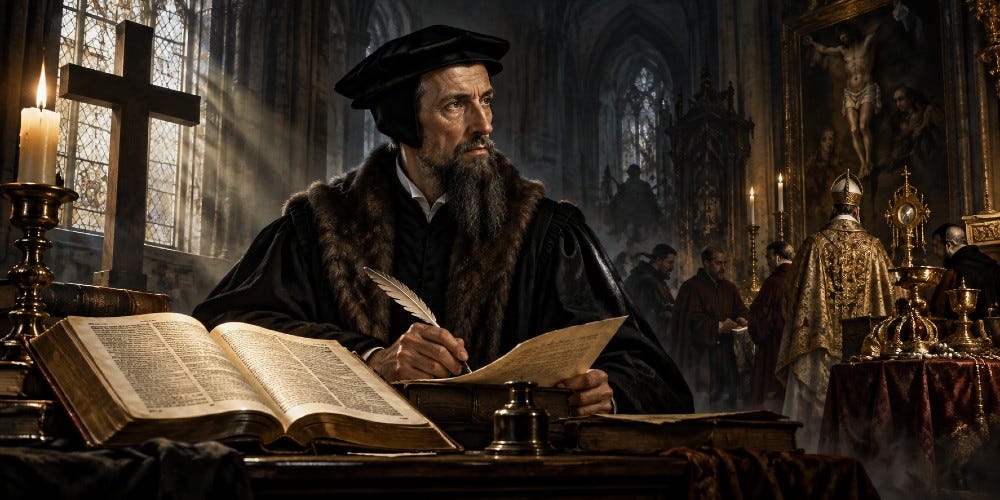
John Calvin did not write a polite suggestion. He wrote a demand. Late in 1543 he prepared The Necessity of Reforming the Church for Emperor Charles V and the German princes gathering at the Diet of Speyer. The church, he said, could no longer tell a sinner how God must be worshiped or where peace with God could be found. That was not a branding problem. That was death.
The title of the work is the argument. Necessity. Not mood. Not taste. Not a committee’s five-year plan. If the Word of God has been buried, delay is disobedience.
Two Questions That Decide Everything
Calvin refused to drown the emperor in every disputed ceremony. He narrowed the case to two questions that swallow the rest. How is God rightly worshiped? Where is salvation found? Images, prayers to the dead, justification, the sacraments, discipline, and church government all matter because they either serve those two concerns or they destroy them.
When these are kept out of view, though we may glory in the name of Christians, our profession is empty and vain.
That sentence should still make pastors sweat. A crowded building and a Christian label prove nothing. R.C. Sproul later put the same fight in the language of the solas. The formal cause was authority. The material cause was justification. Scripture binds the conscience. Faith receives Christ. Works do not buy what Christ already purchased.
Worship Became Theater and Idolatry
Calvin’s charge against the worship of his day was not that it lacked beauty. It lacked obedience. God forbids new worship unsanctioned by His Word. Invented rites offended Him. By that standard, Calvin said the common form of worship was “nothing but mere corruption.” He called it gross idolatry. Images. Saints as mediators. A table turned into a repeated sacrifice. Ceremonies stacked on ceremonies until the people could no longer tell the difference between Christ’s ordinance and a priest’s invention.
This is where the modern church likes to smirk at the sixteenth century and then repeat the same sin with better lighting. If God did not command it, enthusiasm does not baptize it.
In vain they do worship me, teaching for doctrines the commandments of men.
That was Christ’s verdict on a religious class that loved tradition more than the commandment of God. It was not aimed only at Rome.
Salvation Was Buried Under Works
The second question is more brutal. Where does a guilty man find peace? Calvin said men, “intoxicated with a fatal confidence in works, sought salvation anywhere rather than in Christ.” The benefit of redemption was frustrated. Grace lay half-buried, then torn. That is not a metaphor for bruised feelings. That is a description of a system that points sinners to penance, merit, purgatory, and purchased relief instead of to the finished work of the Son.
Justification is God’s courtroom declaration, not a drip of sacramental improvement that might hold if you keep the appointments. Rome still treats justification as a process the church manages. The Reformers treated it as a verdict God speaks over the one who believes. If that verdict can be postponed, sold, or topped off by human satisfaction, Christ is no longer enough. He is a helper. Helpers do not save.
Sacraments Became Merchandise and Pastors Became Tyrants
Robert Godfrey notes that Calvin treated worship and salvation as the soul of the church, sacraments and government as the body. The body had rotted. Ceremonies invented by men were ranked with mysteries instituted by Christ. The Lord’s Supper became a theatrical exhibition. Its use was converted into trafficking for gain. That is a polite way of saying souls were priced.
Then came the shepherds. Calvin said those who sat in the seat of pastors injured the church first by dissolute lives and then by a cruel tyranny over souls, leading men like sheep to the slaughter. He denied that the Roman see was apostolic. He denied that the man who persecuted the gospel was the vicar of Christ. He denied that the one tearing the church from her only Head could claim to be her head. Soft ecumenism hates that paragraph. Scripture does not.
Liberty of conscience was not a slogan for Calvin. It was blood-bought. “This freedom, which was purchased by the blood of Christ, cannot be infringed.” Human laws dressed up as holiness still bind what Christ has loosed. The costume changes. The bondage does not.
Reform That Waits Is Reform That Lies
Calvin organized the treatise around the diseases, the remedies, and the reason the patient could not wait. The church was not mildly unwell. Doctrine was adulterated. Worship was vitiated by superstition. Sacraments were profaned. Government had become confusion and devastation. When God raised up Luther and those who followed, they did not discover a new religion. They lit a torch in a room that had grown dark on purpose.
The same two questions judge this hour. Who may prescribe worship? Where may the conscience rest before God? A church that answers with brand, vibe, politics, or papal memory has already left the text. A church that cannot say, without stuttering, that a sinner is justified by faith in Christ alone has already started selling something else.
Calvin wrote for an imperial diet almost five centuries ago. Charles V did not become a Reformer. The questions outlived the emperor. They will outlive the present mood as well. Every congregation that wants Christ to rule by His Word still has to answer them, and the answer cannot be a shrug.