

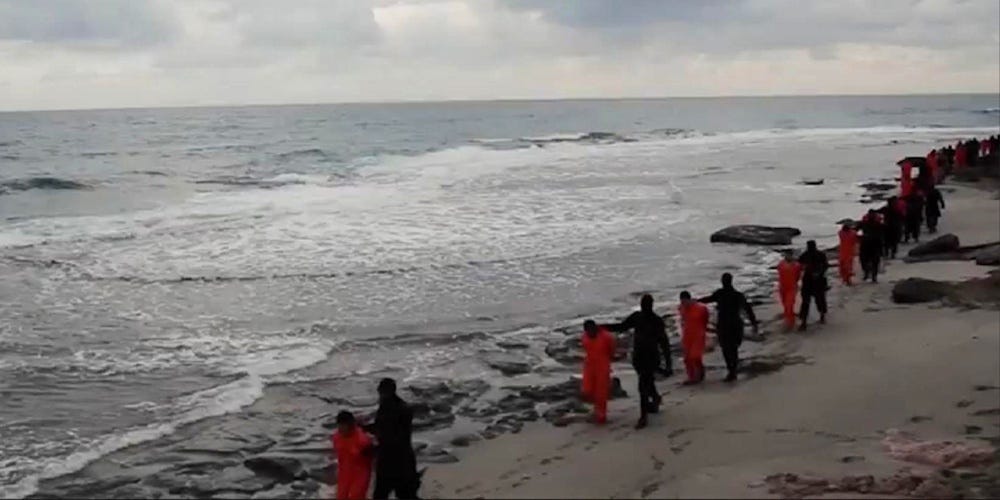
Twenty Coptic laborers were marched onto a Libyan beach in orange jumpsuits and told to deny Christ. Beside them stood a Ghanaian who had not come to Libya to die for Jesus. He watched them refuse. Then he chose their God and their grave.
That is the story that needs to be told again and again until everyone hears it. Change the circumstances and it could have easily been a story from the Book of Acts. That’s how powerful it can and should be.
On February 15, 2015, Islamic State fighters released a video they titled “A Message Signed with Blood to the Nation of the Cross.” Twenty Egyptian Copts and one African worker knelt in the sand near Sirte. Knives came out. The men prayed. Most of the Egyptians were from Minya, thirteen of them from the village of Al-Our. They had gone to Libya for construction wages. ISIS kidnapped them in late 2014 and January 2015, starved them, beat them, and offered them Islam as a way out. None of the twenty took it.
Then there was the twenty-first.
Their God Is My God
His name was Matthew Ayariga. He was a migrant worker from Ghana. He was not Coptic. He had not grown up in those Nile villages. He was not on the first lists the Church in Minya released, because the first lists only had twenty names. The camera made the difference obvious. One dark-skinned man in a line of Egyptian faces.
The killers gave him the easy door. Reject Christ. Walk away from the Copts. Live. A Barnabas Aid account of that moment is the one the faithful have carried ever since. A terrorist asked him if he rejected Christ and demanded he follow Islam. Ayariga looked at the men who had already decided to die and answered for the record of Heaven.
Their God is my God.
He was killed with them. Twenty Christians went to that beach prepared to die. Twenty-one were martyred. A recent remembrance put it the same way, and it is the right way. He saw their faith and he wanted that God more than he wanted another year of paid work in a broken country.
This is not complicated theology. It is the oldest Christian arithmetic there is. A man watches other men refuse to curse Jesus, and something in him breaks open. The sand becomes a baptistry. The knife becomes the seal.
Whosoever therefore shall confess me before men, him will I confess also before my Father which is in heaven.
They Filmed It to Frighten Rome
ISIS did not hide the motive. The lead executioner talked at the camera about the “Nation of the Cross” and promised they would conquer Rome. They dressed the laborers like the prisoners in their other snuff films. They rehearsed. They wanted the West to flinch and the Copts to recant.
It failed on both counts. CBN later reported what a captured guard admitted. The men had already been tortured for weeks. The beach was the third pass with cameras rolling. Still they prayed. Witnesses and families say the last words on many lips were “Ya Rabbi Yasou” — O Lord Jesus.
That is not a political slogan. That is a man handing his spirit to the same Lord Stephen saw standing while the stones fell.
Egypt answered with airstrikes. The world answered with a news cycle and then a shrug. Al-Our answered by building a church.
The Twenty-First Body Came Home Last
The remains were found in a mass grave after an ISIS prisoner talked. The twenty Egyptians were flown home in May 2018 and laid in the Church of the Martyrs of Faith and Homeland in Al-Our. Ayariga had no family claiming him in Ghana that the authorities could find. His body sat unclaimed until September 2020, when Libya released it and Egypt received the last brother. The Christian Post recorded the scene. A mother who had already buried two sons said their joy was complete.
Pope Tawadros II had already written all twenty-one names into the Coptic synaxarium a week after the video. In 2023 Pope Francis entered them in the Roman Martyrology as a sign that the blood was also a seed of unity. Last month the Diocese of Fort Worth announced what the comfortable American church is late to notice. St. Matthew Ayariga Catholic Church in Arlington will be the first parish in the world under his patronage, and the first Ghanaian national Catholic parish in the United States. Dedication is set for January 29, 2027.
Bishop Michael Olson said the terrorists meant to silence the Name and instead handed the world witnesses. He is right. A short film, The 21, produced with Jonathan Roumie as executive producer, was shortlisted for an Academy Award in 2025. Hollywood noticing a Coptic martyrdom is not the miracle. The miracle is that a Ghanaian laborer looked at twenty doomed Copts and decided their Christ was worth the blade.
Do Not Look Away
International Christian Concern marked the tenth anniversary last year and quoted Commissioner Vicky Hartzler. Remember the twenty-one young men murdered solely for being Christian. The age of martyrs did not close with Nero or the Soviet camps. It is open. Nigeria bleeds. Egypt still buries. Libya still has sand that held their blood. Soft churches in the West treat “martyr” like a branding word for people who lost a follower count.
Ayariga did not lose a follower count. He gained a confession. Twenty men walked onto that beach already belonging to Christ. One man walked on as a spectator and walked into eternity as a brother. That is why the count is twenty-one. That is why the shrine in Al-Our has a twenty-first place. That is why a parish in Texas will bear a Ghanaian name most Americans still cannot pronounce.
Never forget the twenty-one. Say the sentence he gave the killers, and mean it before it costs you anything. Their God is my God.